A gorgeous supernatural fable about the folly of men with dreams larger than their abilities and their women who suffer as a result. With its thought-provoking themes, rich atmosphere, and brilliant direction, Kenji Mizoguchi’s Ugetsu is a towering classic of world cinema.
For the casual cinema-goer, it’s easy to imagine that Japanese horror cinema began in earnest in the late 1990s with Hideo Nakata’s Ringu. That certainly opened the world up to a refreshing vein of supernatural cinema but it’s little surprise that Nakata’s shocker was perched upon the shoulders of giants. Although a gentle antecedent, the great director Kenji Mizoguchi’s masterpiece, Ugetsu monogatari remains one of the most remarkable ghost stories in the annals of cinema. Granted, this isn’t really a film that sets out to scare anyone, it’s resolutely more drama than horror, yet the universality of its story, and the film’s pitch-perfect direction, build an eerie power.
The story concerns a potter who, in times of war, sees the promise of great profit by selling his wares to competing militaries. The possibility of so much money, enough to lift him and his family out of subsistence-living, inevitably makes him lose sight of that which he truly holds dear, his wife and son, and he is visited by tragedy. Led by a stellar cast of classic Japanese actors, including Masayuki Mori and the ever amazing Machiko Kyô, what impresses even more is Mizoguchi’s exceptional direction, particularly his use of sequence shots- long, complex takes playing out without a single edit. Within an uninterrupted frame the corporeal and spirit worlds intermingle seamlessly, vying for the protagonist’s senses. It is often so delicate one might feel an intruder into someone else’s dream.
The film’s closing shot, a technically simple lift of the camera that, in the context of the vista it opens, communicates vast realms of information and more vitally, of hope, remains one of the greatest moments in all of cinema. Couple that with the film’s unusually feminine edge (albeit a mainstay of Mizoguchi who, while not exactly a feminist, found his greatest success in tales of tragic heroines) and Ugetsu is surely one of the loveliest ghost stories ever told.
In praise of Ugetsu, Martin Scorsese wrote:
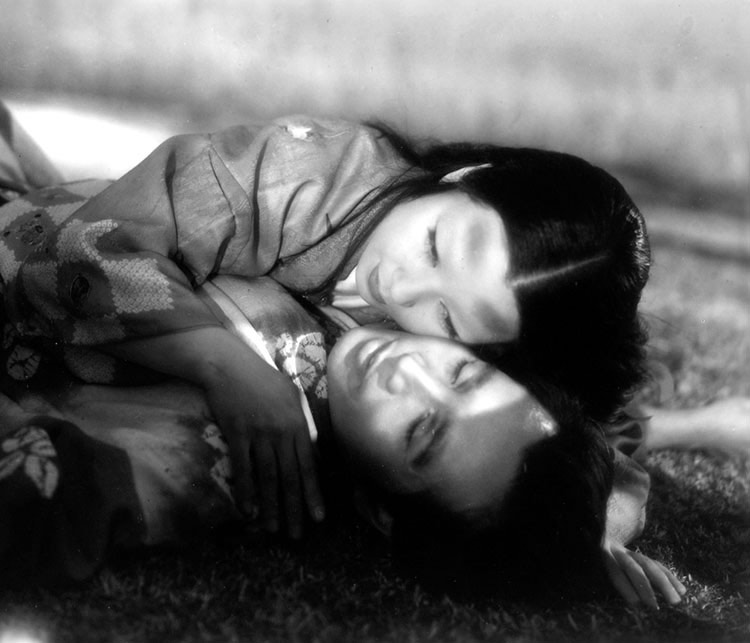
Mizoguchi is one of the greatest masters who ever worked in the medium of film; he’s right up there with Renoir and Murnau and Ford, and after the war he made three pictures—The Life of Oharu, Ugetsu, and Sansho the Bailiff—that stand at the summit of cinema. But Ugetsu has the most powerful effect on me. There are moments in the picture, famous ones, that I’ve seen again and again and that always take my breath away: the boat slowly materializing from out of the mist and coming toward us . . . Genjuro collapsing on the grass in ecstasy and being smothered by Lady Wakasa . . . the final crane up from the son making an offering at his mother’s grave to the fields beyond. Just to think of these moments now fills me with awe and wonder.