Presentation
Considered one of Giuseppe Verdi’s greatest accomplishments, Rigoletto continues to enthrall audiences worldwide with its tragic plot and famous arias. One of the most popular arias of all time, “La donna e’ mobile,” is so catchy that prior to Rigoletto’s premiere in Venice of 1851, Verdi swore the tenor to secrecy, forbidding him to sing, hum, or whistle it anywhere except in his private rehearsals.
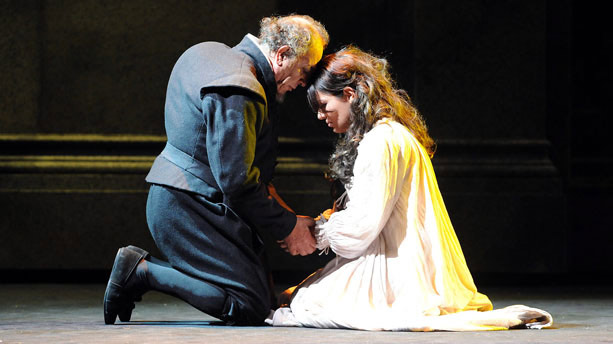
A tragedy of social injustice and inequality, Rigoletto explores the self-hate of the titular hunchbacked court jester, a typical Verdian character who oscillates between affection for his daughter and contempt for the nobility. Caught up in the Duke’s lascivious lifestyle, Rigoletto is cursed for his complicity. An intense drama of passion, deceit, filial love, revenge and murder, Rigoletto perfectly combines melodic richness with dramatic power, both being features which characterize Verdi’s opera masterpieces and ensure them a permanent place in the world’s operatic repertoire.

To subscribe to the entire Opera/Ballet Series and get your discount please click this link
Synopsis
Act 1:
During a party at the Duke’s palace in Mantua, the Duke brags of his romantic conquests. He surveys his court to choose a woman with whom to pass the night and selects the Countess Ceprano. Rigoletto, the hunchbacked court jester, mocks her cuckolded husband. Marullo reveals that Rigoletto has a secret lover whom he goes to see each night. Together with the Count of Ceprano, they decide to kidnap the woman. The Count of Monterone enters, demanding justice for the honor of his daughter, who was seduced by the Duke. Rigoletto insults him, and Monterone curses the Duke and Rigoletto. Rigoletto is very troubled by the curse, and fears for the safety of his daughter, whom he has kept carefully hidden from the courtiers.
On his way home, the jester meets Sparafucile, an assassin who offers him his services, but Rigoletto declines. He returns home and greets Gilda, his daughter, the woman the court mistakenly suspects of being his lover. When Rigoletto leaves, the Duke bribes Gilda’s governess, and presents himself to Gilda as a poor student named “Gualtier Maldè.” He declares his love for Gilda, whose beauty he admired in church. He hears footsteps, and escapes. The courtiers approach and trick Rigoletto into helping them kidnap Gilda.
Act 2:
The courtiers tell the Duke that they have abducted Rigoletto’s lover and that she is enclosed in the Duke’s bedchamber. He realizes that it is Gilda, and excitedly goes to her. The jester confronts the courtiers, and astonishes them by saying that they have kidnapped his daughter (not his lover.) A bed-tousled Gilda enters. Alone with her father, she confesses her love for the Duke. As Monterone is being taken to the dungeon, Rigoletto vows vengeance on the Duke who has ruined his daughter.
Act 3:
Rigoletto has brought Gilda to Sparafucile’s inn to show her the real nature of the man she loves. The Duke, once again incognito, flirts with Sparafucile’s sister, Maddalena. Gilda laments his faithlessness, but still loves him. Rigoletto sends her home, disguised as a boy in order to avoid notice. Rigoletto then hires Sparafucile to kill the Duke. According to their agreement, Sparafucile will kill the Duke and deliver him in a sack to the jester. However, his sister wants to save the handsome young man. Therefore, they decide to kill the first person to appear at the inn, in order to deceive the hunchback. Gilda, having heard everything, knocks at the inn’s door, ready to die in order to save the man she loves. She enters the inn, and is stabbed. Sparafucile gives Rigoletto the sack with the corpse, but in the distance, the Duke can be heard singing. With horror, the hunchback discovers that Gilda is in the sack; she dies, asking for his forgiveness, and Rigoletto remembers Monterone’s curse.
From the Teatro Regio di Parma